xtodo JavaScript js
Prototype Based Object System (Object Based Inheritance)
- JavaScript is a prototype based object system. (Not class based as in Java and Python)
- JavaScript prototype system means, every object may have one parent object, and when property is accessed, it checks the ancestor line to look for the property.
- You can specify the parent object when you create a object.
- You can also change the parent object anytime.
- This is a very simple system, and is nice in JavaScript.
History of JavaScript Constructors and Class Complexity
- JavaScript is originally named Mocha, and then LiveScript.
- Designed in 1995. It is meant to be a easy scripting language for non-programers who are writing HTML, to make it possible to have interactive dynamic HTML.
- JavaScript tried to look and feel like Java language's class based object system.
- This is done for social marketing reasons back in 1995.
- Java was new programing language, as a competitor to the C++ programing language, and it is heavily advertised.
- Sun Microsystems, the creator of Java, made a deal with Netscape, to have Java bundled as part of the Netscape browser.
- For this reason, LiveScript is renamed to JavaScript, and one goal is to have it look like Java.
- This forcing JavaScript to be like java, is technically a very bad thing from a programing language design point of view.
- You are basically forcing 2 incompatible systems to be similar.
- A prototype based object system is incompatible with class based object system.
- This results in a lot complexity in JavaScript.
- What made it worse, is that the design is done badly and in a rush.
- It is said, the whole design and implementation of JavaScript is done in 10 days. (by Brendan Eich)
Unnecessary and Bad Complexity in JavaScript
- Unnecessary and confusing Operator
new - Unnecessary and unpredictable value in Keyword
this - Unreliable Operator
instanceof - Magical prototype key
prototype - Magical prototype key
constructorand is unreliable.
2015 Addition of the Keyword Class
- In 2015, JavaScript tried to have a overhaul of design, yet remain backward compatible, so they added a new
classkeyword. - This did not help, because, one can create object and parent easily and simply without using any of the complex
newandthis. - But most industry programers are used to
newandthis, thinking it's similar to other popular language's class based system such as Java, Python. - So the JavaScript committee decided to add
classkeyword, yet still JavaScript object system has nothing to do with Java's Class System, nor Csharp, Python, Ruby, PHP.
This chapter, is detailed explanation of these.
Where does the async part came from?
when JavaScript runs new promise(executor), it creates a internal while loop so it doesnt wait for the executor to finish.
the control of calling new promise(executor) is immediately released.
in the while loop, JavaScript runs the executor and also runs your code that follows the new promise(executor).
the while loop checks the state of the promise. When the state is settled, it exit the internal while loop.
so you have the illusion of parallel execution of the promise code.
but because JavaScript is so-called single threaded, its actually doing a internal while loop to emulate the async effect.
gah, it's fairly complicated to understand how JavaScript async works, while it being so-called single-threaded.
you can't understand it unless you have some understanding of how os thread or process works and js's interaction with browser.
basically, the question is, if i can call setTimeout in js, what is js actually doing that seems to have the illusion of async or concurrent or parallel.
big session chatting with ai. the round-the-clock oracle.
it is telling me about stack, macrotask, microtask.
ai chat link in next post.
https://grok.com/share/c2hhcmQtMi1jb3B5_885dd517-091d-4d63-b166-aaf25ac5997e
The Error cause feature, standardized in ECMAScript 2022, allows developers to chain errors by passing the original error as a property in the Error constructor's options object. This is achieved using the syntax new Error("message", { cause: originalError }), which preserves the original error's stack trace and type for better debugging.
JavaScript private class fields are declared by prefixing the property name with a hash symbol (#), ensuring they are strictly inaccessible from outside the class scope. This feature, standardized in ES2022, provides true encapsulation enforced by the JavaScript engine, preventing access, enumeration, or deletion via standard object methods.
Key characteristics include:
- Hard Privacy: Private fields are scoped to the class body; subclasses cannot access parent private fields, and external code cannot retrieve them even with reflection.
- Declaration Required: The field must be declared in the class body (e.g., #field;) before it can be assigned or accessed; creating it dynamically via this.#newField results in a syntax error.
- Name Collision Avoidance: The # is part of the name, so a private field #x never clashes with a public property x.
- Static Support: Private static fields (static #field) allow class-level private data accessible only via the class name (e.g., MyClass.#field), not via this.
(ai answer)
class MyClass {
  // Declare private field
  #privateValue = 42;

  constructor() {
    // Accessible within the class
    console.log(this.#privateValue); // 42
  }
}

const instance = new MyClass();
// console.log(instance.#privateValue); // SyntaxError
- complete update on my JavaScript in depth tutorial. (search and remove all xtodo) go thru all ecma. JS: ECMAScript New Features. 2015 to 2026
String.raw Property???
The first argument has a property key "raw". Its value is the raw string.
- xtodo
- 2015-10-26
- explain, about tagged template string, where the “tag” isn't just a function. that's prob wrong perspective. the tag can be ES6 MemberExpression or CallExpression
- show example of using the default String.raw()``
- evaluate the quality of this tutorial http://xahlee.info/js/js_import.html
- https://x.com/i/grok/share/poQlwm9jttNoIFunf5H5rcpNw
- whats jsr format in js
- https://x.com/i/grok/share/T0k6ApkwmqyvmyhS0oJ66IGyI
make functional programing example
- search “Function form lets you manipulate expressions”. e.g. reflect.get page. create a new page showing example. and all pages link to it.
- how to use deno to convert markdown to html
- https://x.com/i/grok/share/iLLGSyjItzPRaNyMSStYocxx5
- whats the problem of js not having int and float type
- https://x.com/i/grok/share/lEGFBnP9vGUcwodzWGRbTpY7z
- lol. silly youtube zoomers.
- but that's a good idea for javascript to gen this
- 2025-04-29
- JavaScript fix snow fall page. make it all just fall, no bounce back.
- make it number of flakes according to screen size
- JS DOM: Falling Snow Effect
- 2025-04-29
- review my js iterator generator etc. need to be able to control reset or not
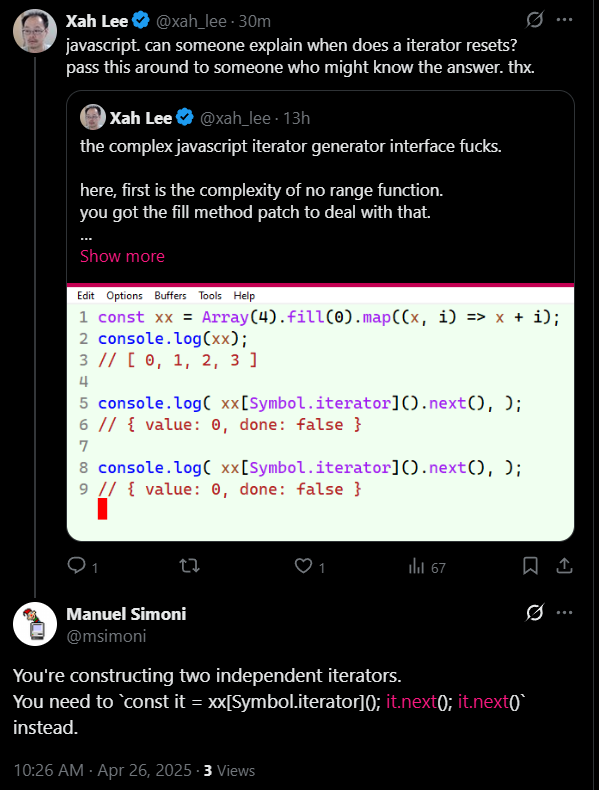
const xx = Array(4).fill(0).map((x, i) => x + i);
console.log(xx);
// [ 0, 1, 2, 3 ]

// yy = xx[Symbol.iterator];

// console.log( yy )

// console.log( yy() .next() )

console.log( xx[Symbol.iterator]().next(), );
// { value: 0, done: false }

console.log( xx[Symbol.iterator]().next(), );
// { value: 0, done: false }

/*
the complex javascript iterator generator interface fucks.

here, first is the complexity of no range function.
you got the fill method patch to deal with that.

then, am trying to deconstruct the iteratable interface, trying to get its next value.
but apparantly it resets.

very complex, because the iterable contains a property of type symbol, named Symbol.iterator.
it's value must be a function.
and it must return a object, this object must have a next property, and this property's value must be a function.
this is why u get this funky
xx[Symbol.iterator]().next()

its return value, is a object, that contains value and done keys.

yet, somehow it resets. am unable to get it to 0, 1, 2, 3, etc.
 */
- what's new in js 2022
- https://x.com/i/grok/share/9EcaXLsckPXkiZ23QGbCjE9LO
- ecmascript 2022
- number input forms
- need to fix the char frequency. need more corpus Ergonomic Keyboard Layouts
- Character Frequency Plot
- 2021-04-29 work in progress
- bigram calculator
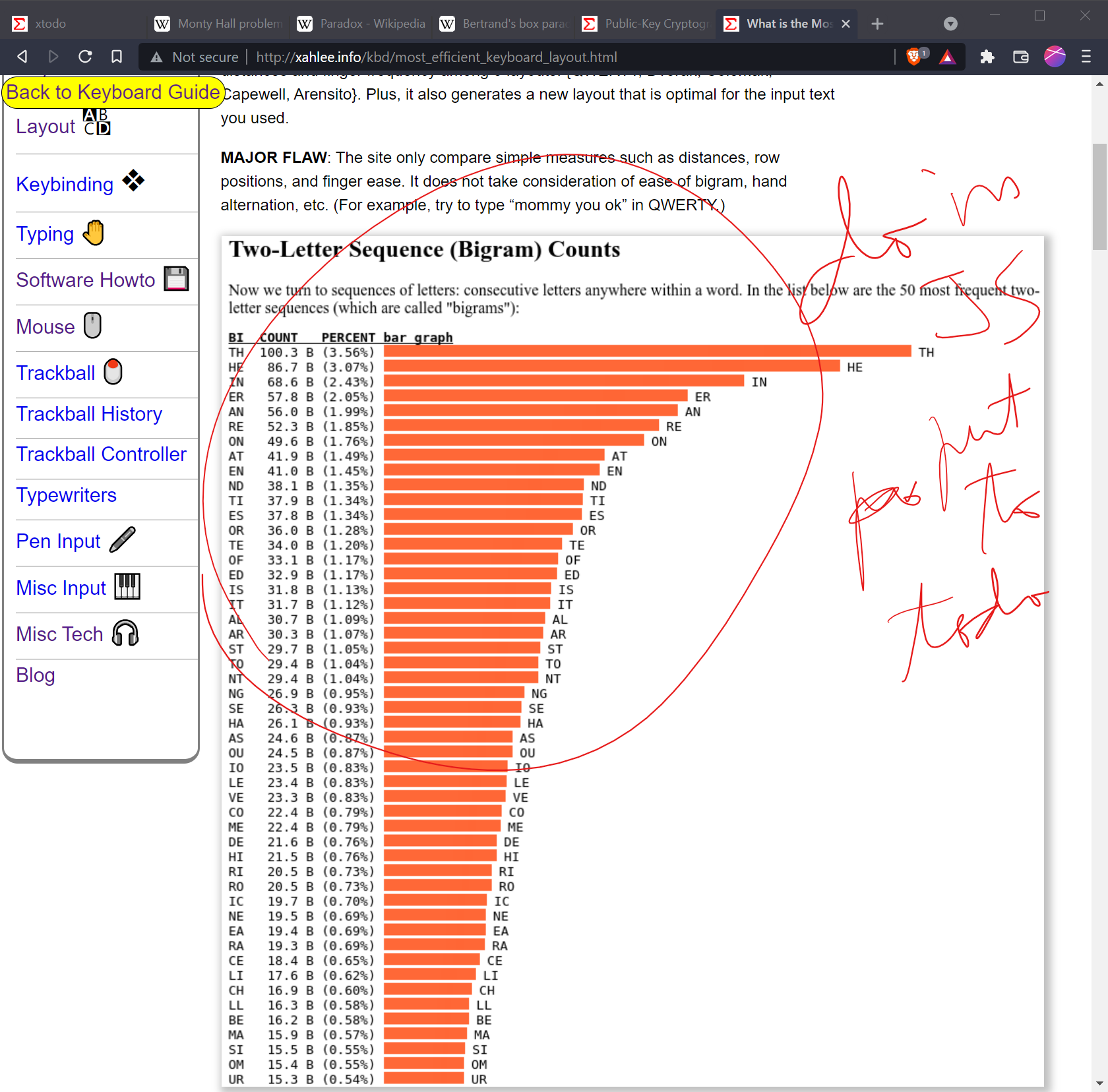
- 2021-04-09 write a interactive JavaScript to compute bigram chart. What is the Most Efficient Keyboard Layout?
- 2022-09-29 write code to count word frequency, of my site. and bigram. use golang and WolframLang
- change char frequency chart diagram to svg. e.g. Myth of QWERTY vs Dvorak Layout , check all pages.
- 2021-05-20 change to svg Russian Keyboard Layout
- 2021-11-26 add how to add a style sheet on the page. See also: JS DOM: Change CSS. look at the code for unicode search.
- 2023-10-31 node.attributes JavaScript
js walk dir
- show deno code that list files in s folder and nested folder, using only deno core
- https://x.com/i/grok/share/wgDKtaPZtgpCZCac2gWwjKg4Q
- does deno have builtin lib that does not require internet access
- https://x.com/i/grok/share/ELVCzl3RQ9do0z3B9GO6z3tlJ
- JavaScript deno walk dir https://deno.land/std@0.135.0/fs#expandglob
Georrg, 11/03/2022 @XahLee standard library has walk and walkSync functions
- async: https://deno.land/std@0.162.0/fs/walk.ts?s=walk
- sync: https://deno.land/std@0.162.0/fs/walk.ts?s=walkSync
import { walkSync } from "https://deno.land/std@0.162.0/fs/walk.ts";

for (const entry of walkSync(".")) {
console.log(entry.path);
}
- 2022-09-26 JS: JSON.stringify, doc optional args
- 2022-09-26 JS: JSON.parse , doc optional args
- 2022-08-21 test innerText , and also more study on nodeValue
- JS DOM: innerHTML, textContent, innerText, nodeValue
- 2022-09-04 update
- jQuery Selector vs DOM querySelectorAll
- 2022-09-04 review
- JS DOM: innerHTML, textContent, innerText, nodeValue
- 2022-09-04 JavaScript Java class model vs JavaScript class model
- 2022-09-02 JavaScript maybe delete any mention of “also is a Iterator”
- JS: Iterator
- 2022-08-31 group the object properties
- JS: Object.keys
- Difference Between Implied Global and True Global Variable JS: Global Variable
-
2022-10-14 write a
xah_is_map_equalandxah_is_set_equal
- 2022-07-28
- JS: Symbol.prototype
- 2022-03-26 JavaScript obfusticate my unicode search code https://github.com/javascript-obfuscator/javascript-obfuscator
- 2022-03-14 JS: Symbol (class) need complete
- need list of all unicode properties JS: Regex Unicode Property
- 2022-02-19 add how to use python to do it
- Unicode: Letter Character
- Python: Get Unicode Name, Code Point
- Python: Unicode
- 2022-01-11 JavaScript svg, need to rewrite Emacs Key Layout Diagram
- 2021-12-17 JavaScript, write a syntax highlight. start perhaps for elisp. just do simple word highlight. use regex. highlight vars if possible. highlight comment. possibly even ignore string.
- 2021-05-20 . write JavaScript svg keyboard diagram
- write a js to generate keyboard svg diagram
- ;; 2022-04-03 There's a new notation for key, based on finger.
- ;; For example the qwerty e key is Lp2p1.
- ;; The notation is like this: [left or rigt hand][column number][row number].
- ;; L means left hand, R means right hand
- ;; Column position, pointing finger is 1, index is 2, ring finger is 3, pinky is 4, and so on in that direction. Thumb is 0. In the thumb direction is -1, -2 etc.
- ;; Row position, home row is 0. Above is 1, below is -1.
- ;; Positive number are written with p in front. Eg p1, p2. Zero is p0. Negative can be written with n in front, eg n1, n2.
- ;; This system is a notation system for keyboard physical layout, which also indicates associated finger for that key.
- ;; The advantage is that it's a logical system, not based on arbitrary table lookup.
- ;; Qwerty, dvorak, etc can then be mapped to this logical system.
- a text diagram of letter layout map to fingerposition
- qwerty letter map to fingerposition
- dvorak letter map to fingerposition
- fingerposition map to center of key
- 2021-11-15 create keyboard layout JavaScript
- layout draw
- Xah Talk Show Keyboard Heatmap JavaScript + SVG
- Xah Talk Show 2020-09-26 JavaScript live coding keyboard layout heatmap
missing some. create new page for them.
- JS: Object .prototype .constructor
- JS: Array.prototype.constructor
- JS: Function.prototype.constructor
- JS: Map.prototype.constructor
- JS: Set.prototype.constructor
- JS: String.prototype.constructor
- JS: RegExp.prototype.constructor
- JS: Date.prototype.constructor
- JS: Symbol.prototype.constructor
- JS: Promise.prototype.constructor
- Proxy does not have constructor property
js this-binding argument

// nasty problem in JavaScript involving this-binding

function MakeObj(x) {
this.p = x;
return "lol";
}

function OhMyGodMakeObj(x) {
this.p = x;
return {};
}

const niceObj = new MakeObj(3);
console.assert(niceObj.p === 3);

const godObj = new OhMyGodMakeObj(3);
console.assert(godObj.p === 3, "omg, no work");
// Assertion failed: omg, no work
// oddity in JavaScript involving this-binding.
// a magic “this” bultin var, nothing to do with object oriented programing.

function addone(x) {
return this + x;
}

console.assert(addone.call(3, 4) === 7);

/*
this means, people can write all functions this way,
and the new call syntax is
funname.call(args...)
instead of just
funname.(args...)
*/

/*

the problem here is, in typical programing engineering fashion of speaking, JavaScript leaked the this-binding mechanism for its so-called dispatch in its object-oriented way.

it should generate a error instead, when function use this-binding without being a method.

*/