Xah Talk Show 2025-12-23 Ep732 Wolfram Language, Advent of Code 2025, Day 4, Part 2. take 2
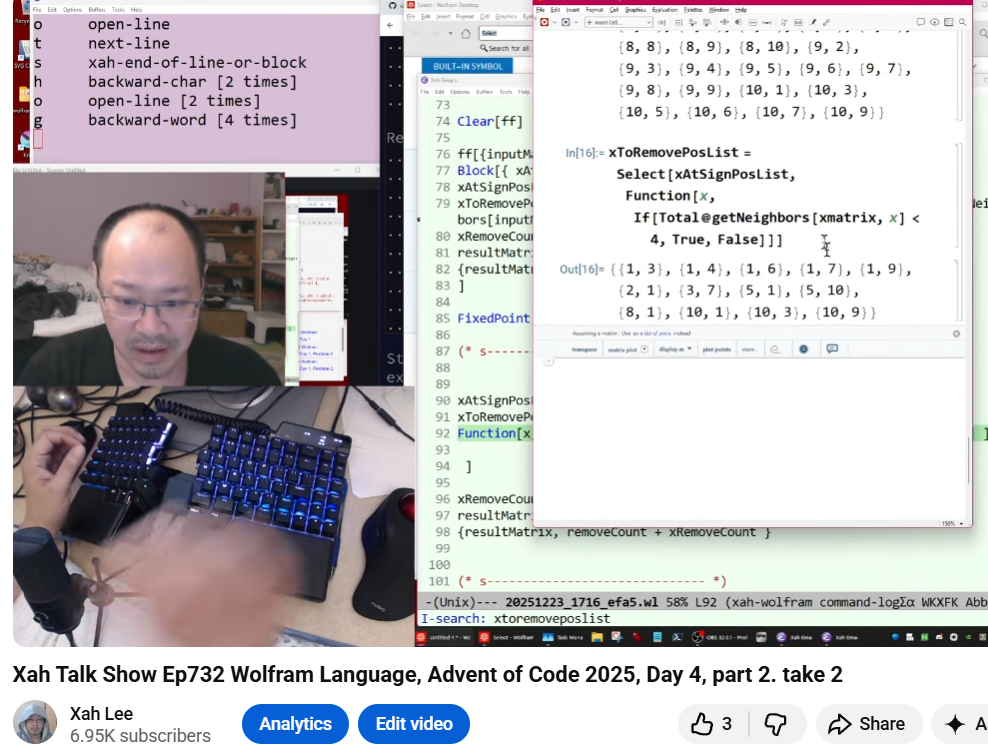
Video Summary (Generated by AI, Edited by Human.)
This video discusses the solution to Advent of Code 2025, Day 4, Part 2 (0:12). The problem involves a grid of @ signs and dots, where the goal is to iteratively remove @ signs that have fewer than four @ neighbors until no more can be removed. The final answer is the total number of @ signs removed (3:40).
The presenter, Xah Lee, codes the solution in Wolfram Language (Mathematica), emphasizing a pure functional programming approach with no variable mutation, for loops, or object-oriented concepts (39:50). He breaks down the problem into sub-functions:
Identifying special @ signs: Finding @ signs with less than four @ neighbors (2:36).
Removing @ signs: Replacing identified @ signs with zeros in the matrix (1:08:49).
Iterative process: Repeating the removal until no more @ signs can be removed, using the FixedPoint function in Wolfram Language (13:18).
The presenter demonstrates debugging steps when the initial code doesn't work, leading to the identification of an incorrect approach to "deleting" elements from the matrix (1:08:49). The final solution for the toy example yields 43 removed @ signs (1:14:41).
xinput =
"..@@.@@@@.
@@@.@.@.@@
@@@@@.@.@@
@.@@@@..@.
@@.@@@@.@@
.@@@@@@@.@
.@.@.@.@@@
@.@@@.@@@@
.@@@@@@@@.
@.@.@@@.@.";

(* turn it into a matrix of 0 and 1 *)
xmatrix = ToExpression /@ Characters /@ (StringSplit @ StringReplace[xinput, {"." -> "0", "@" -> "1"}])

(*
{{0, 0, 1, 1, 0, 1, 1, 1, 1, 0},
{1, 1, 1, 0, 1, 0, 1, 0, 1, 1},
{1, 1, 1, 1, 1, 0, 1, 0, 1, 1},
{1, 0, 1, 1, 1, 1, 0, 0, 1, 0},
{1, 1, 0, 1, 1, 1, 1, 0, 1, 1},
{0, 1, 1, 1, 1, 1, 1, 1, 0, 1},
{0, 1, 0, 1, 0, 1, 0, 1, 1, 1},
{1, 0, 1, 1, 1, 0, 1, 1, 1, 1},
{0, 1, 1, 1, 1, 1, 1, 1, 1, 0},
{1, 0, 1, 0, 1, 1, 1, 0, 1, 0}}
 *)

(* s------------------------------ *)

Clear[getNeighbors]

getNeighbors::usage = "getNeighbors[matrix2d, {row, col}]
returns all the neighbors of a given cell of 2d matrix.
For example, If matrix is
{
{1,2,3},
{4,5,6},
{7,8,9}
}
then,
getNeighbors[matrix2d, 1, 1] returns 2 4 5.
getNeighbors[matrix2d, 2, 2] returns 1 2 3 4 7 8 9.";

(* todo.
each time getNeighbors is called, entire matrix is created.
this is not efficient. *)

getNeighbors[xmatrix_, {xrow_, xcol_}] :=
With[{xUnique = Unique[]},
 With[{xpaddedMatrix = ArrayPad[xmatrix, 1, xUnique] },
DeleteCases[ Map[ Function[x, Part[xpaddedMatrix, First @ x +1, Last @ x +1 ]  ] ,
 DeleteCases[
 Tuples[ { xrow + {-1,0,+1}, xcol + {-1,0,+1} }],
 {xrow,xcol} ]] , xUnique]
]]

(* s------------------------------ *)

(*
algo steps:
Input is a matrix.
Go thru the matrix, remove some cells. Count number of cells removed.
Repeat, untill no cell can be removed.
Get total number of cells removed.
*)

(*
plan.
write a function ff.
ff[{inputMatrix, currentCountOfRemovedCells}]
it will return a list
{newMatrix, totalRemovedCellsCount}
then, the solution is
FixedPoint[ff, {inputMatrix,0}]
*)

Clear[ff]

ff[{xmatrix_, removeCount_}] :=
 Block[{xAtSignPosList, xToRemovePosList, resultMatrix, xRemoveCount},
   xAtSignPosList = Position[xmatrix, 1, {2}];
  xToRemovePosList =
   Select[xAtSignPosList,
    Function[x,
     If[Total@getNeighbors[xmatrix, x] < 4, True, False]]];
  xRemoveCount = Length@xToRemovePosList;
  resultMatrix =
   ReplacePart[xmatrix,
    Map[Function[x, Rule[x, 0]], xToRemovePosList]];
  {resultMatrix, removeCount + xRemoveCount}]

FixedPoint[ff, {xmatrix,0}]

(*
{{{0, 0, 0, 0, 0, 0, 0, 0, 0, 0}, {0, 0, 0, 0, 0, 0, 0, 0, 0, 0}, {0,
   0, 0, 0, 0, 0, 0, 0, 0, 0}, {0, 0, 0, 0, 1, 1, 0, 0, 0, 0}, {0, 0,
   0, 1, 1, 1, 1, 0, 0, 0}, {0, 0, 0, 1, 1, 1, 1, 1, 0, 0}, {0, 0, 0,
   1, 0, 1, 0, 1, 1, 0}, {0, 0, 0, 1, 1, 0, 1, 1, 1, 0}, {0, 0, 0, 1,
   1, 1, 1, 1, 0, 0}, {0, 0, 0, 0, 1, 1, 1, 0, 0, 0}},
43}
 *)
Interesting math question. can be a coding problem. How many neighbors a middle cell of an n dimensional matrix has? (counting diagonals)