JavaScript bundlers. 2011 to 2026
what is a bundler
bundler is tool that takes a js file, find all the “requires” packages declared in it, and bundle them all the code into a single js file.
js did not have modules system before ECMAScript 2015 . People created CommonJS Module System , and is used in nodejs.
it loads library by code like
const math = require('./math.js');
but this isn't supported by browsers.
Thus, use bundler to merge all the js files into one.
browserify. 2011 to 2017

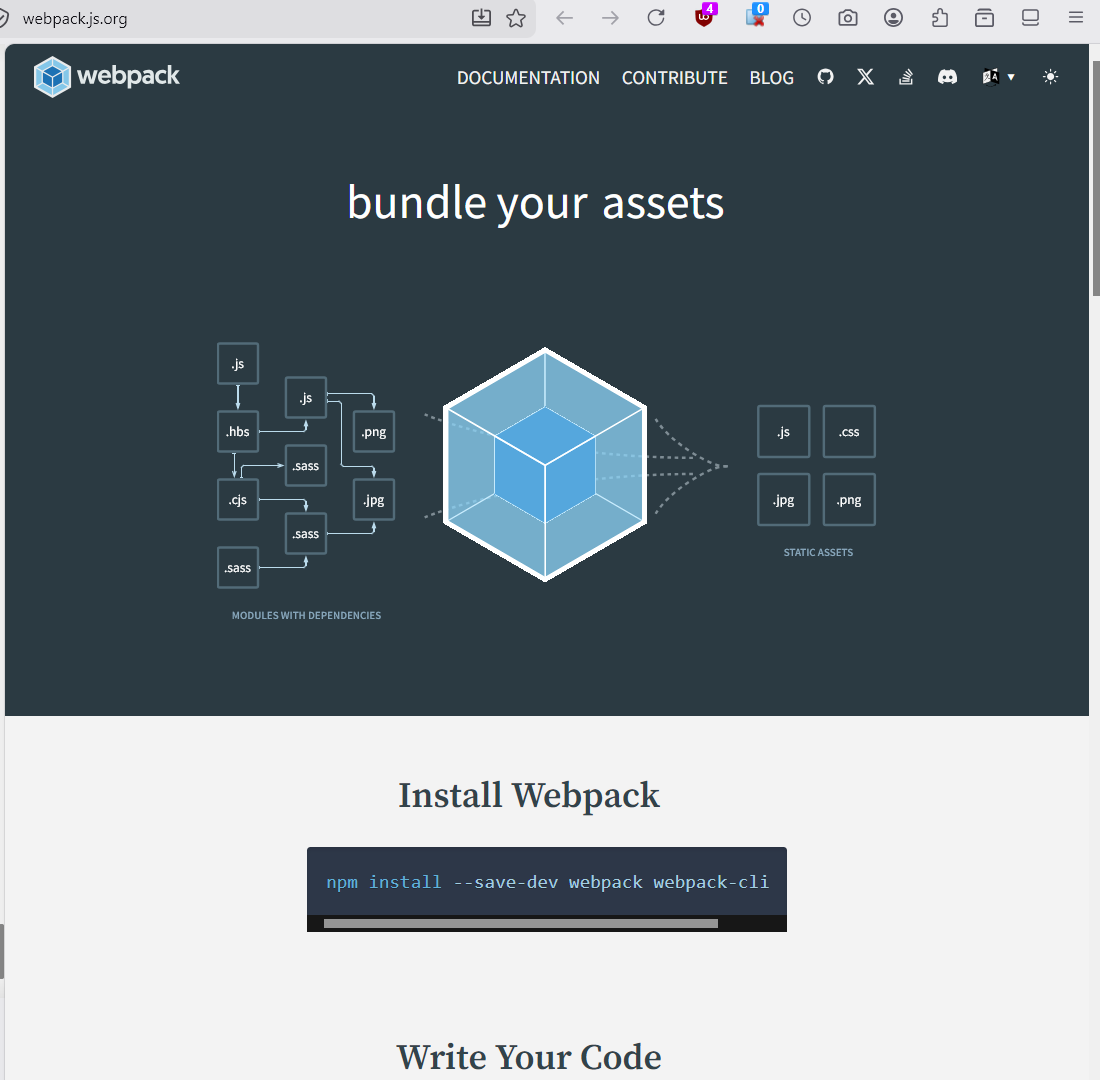
webpack. 2011
rollup, parcel, esbuild, vite, turbopack, rspack, rolldown
ai answer
list major js bundlers and the year they were created
Major JavaScript bundlers and their approximate creation/first public release years:
| Bundler | Year Created / First Released | Notes |
|---|---|---|
| Browserify | 2011 | Early tool that brought Node.js-style require() / CommonJS modules to the browser. |
| Webpack | 2012 | Created by Tobias Koppers; became the dominant general-purpose bundler with loaders/plugins and “everything is a module.” |
| Rollup | 2015 | Created by Rich Harris; strong focus on ES modules, tree-shaking, and clean output (especially popular for libraries). |
| Parcel | 2017 | Zero-config bundler focused on speed and simplicity (public 1.0 / announcement late 2017). |
| esbuild | 2020 | Extremely fast Go-based bundler/minifier by Evan Wallace; widely used as a building block (e.g., in Vite). |
| Vite | 2020 | Build tool/dev server by Evan You (Vue creator); uses native ESM in development + a bundler (historically Rollup, later Rolldown) for production. |
| Turbopack | 2022 | Rust-based bundler from Vercel (webpack creator Tobias Koppers involved); primarily associated with Next.js. |
| Rspack | 2023 | Rust-based, highly webpack-compatible bundler from ByteDance. |
| Rolldown | 2024 (open-sourced; earlier announcement) | Rust-based Rollup-compatible bundler intended as Vite’s next production engine. |
Context / other notes
- Earlier precursors included simple concatenation and task runners (Grunt/Gulp), plus AMD loaders (RequireJS), but true module bundlers took off with Browserify and especially Webpack.
- esbuild and tools like SWC (more compiler-focused, started ~2017–2018) shifted the focus toward native-speed performance.
- Modern landscape (as of 2025–2026) emphasizes Rust/Go implementations for speed (esbuild, Turbopack, Rspack, Rolldown) while Webpack remains important for large/complex or legacy codebases, and Vite is the default for many new projects.
Years refer to initial public release or project start as commonly cited; exact “created” dates can vary slightly depending on first commit vs. announcement vs. stable release.
modern web dev history. 2010 to 2026
- The Ugly JavaScript. 2010 to 2026
- Modern JavaScript Explained For Dinosaurs. By Peter Jang. 2017
- JS: ECMAScript 2015
- JS: CommonJS Module System. 2009 to 2026
- History of JavaScript, 1995 to 2025.
- npm Disease (2021)
- Why was Electron Created (JavaScript framework, 2013)
- JavaScript runtime platforms. 2009 to 2026
- JavaScript package managers. 2012 to 2026
- JavaScript bundlers. 2011 to 2026
- JavaScript UI Frameworks. 2010 to 2026
- JavaScript compilers. 2012 to 2026
- JavaScript task runners. 2012 to 2026
- JavaScript build tools (2026)