Breather Surface (parametric formula)
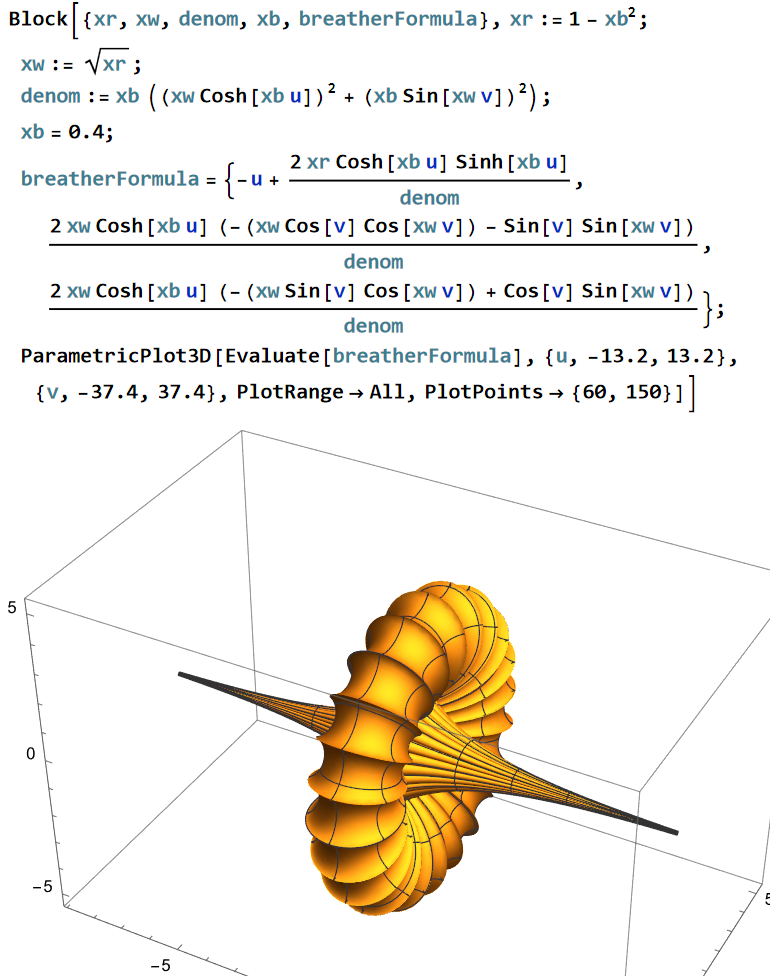
Block[{ xr, xw , denom, xb , breatherFormula },
xb = 0.4 ;
xr = 1 - xb^2;
xw = Sqrt[xr];
denom = xb*((xw*Cosh[xb*u])^2 + (xb*Sin[xw*v])^2);
breatherFormula = {-u + (2*xr*Cosh[xb*u]*Sinh[xb*u])/ denom,
(2*xw*Cosh[xb*u]*(-(xw*Cos[v]*Cos[xw*v]) - Sin[v]*Sin[xw*v]))/ denom,
 (2*xw*Cosh[xb*u]*(-(xw*Sin[v]*Cos[xw*v]) + Cos[v]*Sin[xw*v]))/denom };
ParametricPlot3D[ Evaluate @ breatherFormula , {u, -13.2, 13.2}, {v, -37.4, 37.4}, PlotRange -> All, PlotPoints -> {60, 150}]
]
- u controls how far the tip goes.
- v controls the girth.
- b varies from 0 to 1.
The above image has boundary {u,-13.2,13.2} and {v,-37.4,37.4}, with b=0.4.
There's some request to see this surface breathing.
I asked Richard Palais (https://www.math.uci.edu/~palais/) , he gave me some explanation. Here's from what i understand.
There's this PDE
D[f[x,t],{t,t}] - D[f[x,t],{x,x}] + Sin[f[x,t]] == 0
This is called the Sine-Gordon equation
It turns out, solutions to this equation corresponds to unique pseudo-spherical surfaces. (the function represents the surface in Asymptotic coordinates). i.e. there's a one-to-one map from solutions of sine-Gordon and pseudo-spherical surfaces.
But also, solution to sine-Gordon are of interest to physicists in what's called Soliton. Typically, a solution f[x,t] is plotted as a animation, with t fixed, giving a function of one var x. And with t varies, creates a animation. (t is considered as time) This animation is called a breather, because it looks like a wave that breaths. (you can see this animation in Mac version of 3dxm, under the Wave category).
But since f[x,t] can also be plotted as a parametric surface (a pseudosphere), but since it's a static image, so it doesn't breath.
So the breather surface doesn't really breath. The name is borrowed due to this pseudosphere's formula being a correspondence to a non-linear wave called Breather
There's the question of wheat her there's some kinda visual correspondence between the function f plotted as a 2D animation and plotted as a surface… i don't know.
References:
A Modern Course on Curves and Surfaces , by Richard S Palais. page 108. curves_surfaces_palais.pdf
Lecture notes on curves and surfaces in R3 , by Chuu-Lian Terng. page 60. Surfaces_in_R3.pdf
About Pseudospherical Surfaces (1990s), by Chuu-Lian Terng. Pseudospherical_Surfaces.pdf
What is the significance of Breather Surface (AI answer)
- what is the significance of Breather Surface in geometry
- https://x.com/xah_lee/status/2044286358085349598
- Breather surfaces are a family of surfaces in differential geometry that correspond to "breather" solutions of the sine-Gordon equation.
- They are notable examples of pseudospherical surfaces with constant Gaussian curvature K = −1 (where defined).
Key Properties and Mathematical Significance
- Constant negative Gaussian curvature: Like the classical pseudosphere (a surface of revolution generated by a tractrix), breather surfaces have intrinsic geometry equivalent to the hyperbolic plane (Lobachevsky/Bolyai geometry). This makes them models for non-Euclidean geometry embedded in 3D Euclidean space ℝ³.
- Connection to solitons and the sine-Gordon equation: The sine-Gordon equation ∂²q/∂u∂v = sin(q) arises in integrable systems, relativistic field theory, and nonlinear wave phenomena. Breather solutions are time-periodic, spatially localized oscillatory solutions (like a "bound state" of a kink and antikink that "breathe" in amplitude without dispersing). The breather surface is the geometric realization of such a solution via the Gauss-Codazzi equations or the associated immersion.
A typical parametrization (for a parameter a with 0 < |a| < 1) uses the breather solution:
q(u, v) = 4 arctan[(a / w) ⋅ sin(w v) / cosh(a u)], where w = √(1 − a²).
The surface coordinates (x, y, z) are then derived from this, often involving hyperbolic and trigonometric functions in the denominators, leading to periodic "undulations" along one direction.
- One-parameter family: Varying the parameter a produces different members of the family, with varying "tightness" or frequency of the oscillations.
Visual and Geometric Features
These surfaces resemble a "flower-like" or undulating pseudosphere with periodic bulges, cuspidal edges (where the curvature is singular), and a wavy, non-revolution shape. They do not actually "breathe" (the surface is static), but the name comes from the underlying breather soliton, which oscillates in time when viewed as a wave.
They are often visualized in mathematical software (e.g., Maple, Mathematica, or pgfplots) showing the characteristic periodic lobes or ridges.
Broader Context and Importance
- Soliton theory and integrability: Breather surfaces illustrate how solutions to nonlinear PDEs (like sine-Gordon) can be associated with geometric objects via the "soliton surface" construction. This links differential geometry to physics (e.g., Josephson junctions, crystal dislocations, or certain wave models).
- Examples of constant curvature surfaces: They expand the catalog beyond the standard pseudosphere (Dini’s surface or Kuen’s surface are related). Pseudospherical surfaces are important for understanding hyperbolic geometry in 3D embeddings and for studying Willmore energy or other variational problems.
- Visualization and education: Their striking, organic appearance makes them popular in mathematical art and surface galleries for demonstrating complex parametric surfaces and soliton phenomena.
In short, the breather surface's significance lies in beautifully uniting soliton dynamics, integrable systems, and hyperbolic geometry in a single embeddable object in 3D space. It exemplifies how abstract nonlinear equations manifest as tangible geometric forms. For explicit plots or animations, resources like the Virtual Math Museum or specialized plotting scripts are excellent.