Banking systems running in COBOL on IBM Z mainframes, still (2026)
banking system in cobol
ai answer
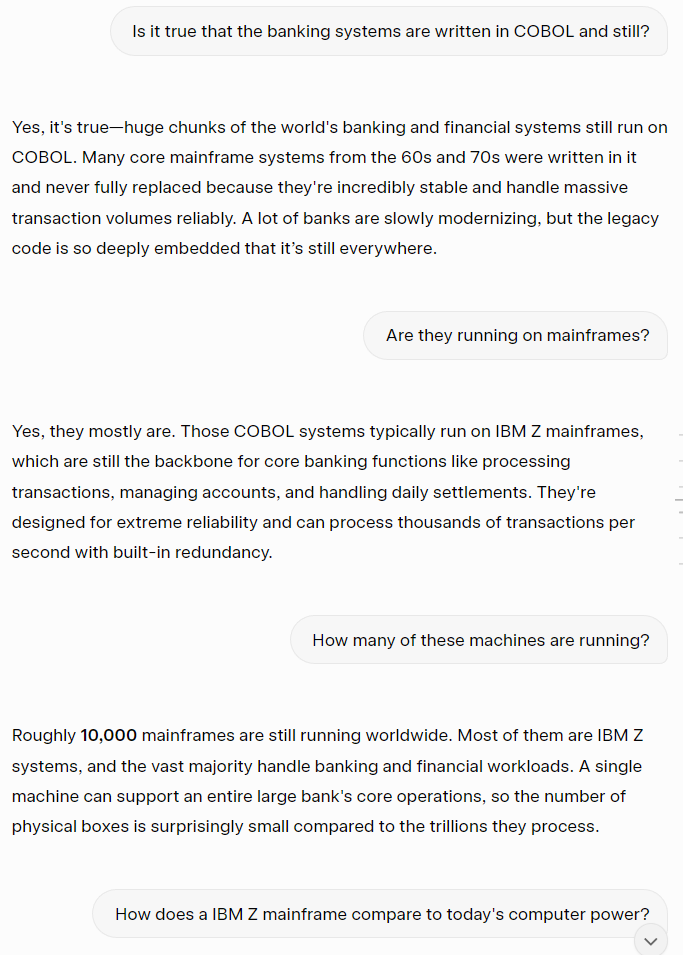
Is it true that the banking systems are written in COBOL and still?
Yes, it's true—huge chunks of the world's banking and financial systems still run on COBOL. Many core mainframe systems from the 60s and 70s were written in it and never fully replaced because they're incredibly stable and handle massive transaction volumes reliably. A lot of banks are slowly modernizing, but the legacy code is so deeply embedded that it’s still everywhere.
Are they running on mainframes?
Yes, they mostly are. Those COBOL systems typically run on IBM Z mainframes, which are still the backbone for core banking functions like processing transactions, managing accounts, and handling daily settlements. They're designed for extreme reliability and can process thousands of transactions per second with built-in redundancy.
How many of these machines are running?
Roughly 10,000 mainframes are still running worldwide. Most of them are IBM Z systems, and the vast majority handle banking and financial workloads. A single machine can support an entire large bank's core operations, so the number of physical boxes is surprisingly small compared to the trillions they process.
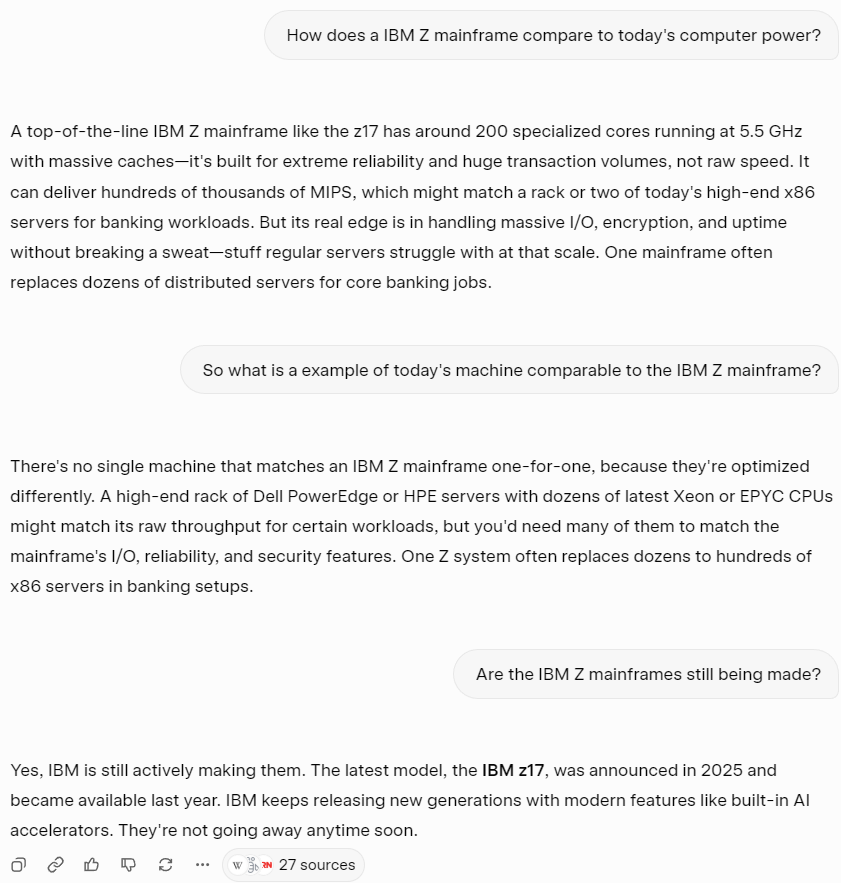
How does a IBM Z mainframe compare to today's computer power?
A top-of-the-line IBM Z mainframe like the z17 has around 200 specialized cores running at 5.5 GHz with massive caches—it's built for extreme reliability and huge transaction volumes, not raw speed. It can deliver hundreds of thousands of MIPS, which might match a rack or two of today's high-end x86 servers for banking workloads. But its real edge is in handling massive I/O, encryption, and uptime without breaking a sweat—stuff regular servers struggle with at that scale. One mainframe often replaces dozens of distributed servers for core banking jobs.
So what is a example of today's machine comparable to the IBM Z mainframe?
There's no single machine that matches an IBM Z mainframe one-for-one, because they're optimized differently. A high-end rack of Dell PowerEdge or HPE servers with dozens of latest Xeon or EPYC CPUs might match its raw throughput for certain workloads, but you'd need many of them to match the mainframe's I/O, reliability, and security features. One Z system often replaces dozens to hundreds of x86 servers in banking setups.
Are the IBM Z mainframes still being made?
Yes, IBM is still actively making them. The latest model, the IBM z17, was announced in 2025 and became available last year. IBM keeps releasing new generations with modern features like built-in AI accelerators. They're not going away anytime soon.